Raise awareness of environmental health issues in order to better protect our children and future generations.

23 April 2013

"Business Bias As Usual: The Case of Electromagnetic Pollution" - Parts 7 and 9

Part 7:  Recent Precautionary Positions on Health Risks of EMF Exposures
Part 8:  How to Promote Protection Against the Health Effects of Exposure to EMF (already posted)
Part 9:  Conclusions 


Following are Parts 7 and 9 from “Business Bias as Usual: The Case of Electromagnetic Pollution”, written by Prof. Angelo Levis, Valerio Gennaro, and Spiridione Garbisa. (The text is without the footnotes, tables, and reference list contained in the original version. The full paper is available here.) This completes the paper.


Professor A. Levis, is an oncologist and professor of Environmental Mutagenesis at the University of Padua (Italy) and member of the National Toxicology (1977-1985) and National Oncology (2008-2010) Commissions. He is also a founder and former president of the Association for the Prevention and Fight against Electrosmog, known as APPLE. www.applelettrosmog.it . Valerio Gennaro is from the National Cancer Research Institute, Genoa, Italy, and Spiridione Garbisa, is a member of the Scientific Committee, International Society of Doctors for the Environment (ISDE), Italy.

“Business bias as usual: the case of electromagnetic pollution” is a chapter published in Elsner W, Frigato P, Ramazzotti P eds: “Social Costs Today. Institutional Analyses of the Present Crises”. Routledge (Taylor&Francis Group), London and New York 2012: 225-68 (www.routledge.com).

7: Recent Precautionary Positions on Health Risks of EMF Exposures

22 April 2013

9th National Congress on Electrosmog, Bern, 20 April 2013: (Pre-Congress) Abstracts of the Five Presentations

About 170 participants from Switzerland, Germany, Austria, Italy, France, Belgium and the Netherlands were able to discuss the latest findings in electromagnetic pollution caused by mobile, wireless and high-voltage lines at the 9th National Congress on Electrosmog, held in Bern on 20 April 2013.

The Congress organizer, Gigahertz, is the largest and most active organization in Switzerland in the field of electro-education. It provides advice to interested persons in the area of mobile communications, wireless, power lines, etc. Every day, telephone and Email inquiries are answered by its professional Center for Non-ionizing radiation. The Center is also available for requests from the press on the phone number 031 731 04 31 at any time.

Following are the abstracts of the five presentations in English. The texts are those which appeared before the Congress on the site of Gigaherz. Abstracts of the presentations are also available here in German: see http://www.gigaherz.ch/1848.  More reports about the Congress will soon be posted on the Gigaherz site. Conference proceedings and a DVD will also be made available.


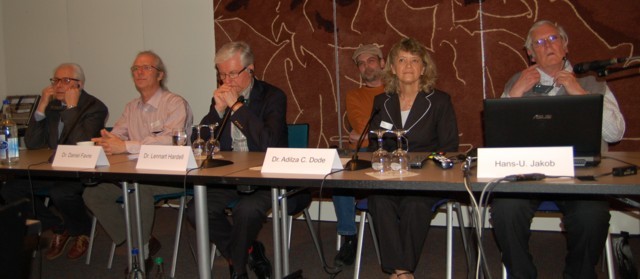
Speakers answering questions from the audience: from left to right:  Professor Angelo Levis, Dr. Daniel Favre,
Dr. Lennart Hardell, Dr. Dode Adilza (with interpreter for Portuguese), and Hans-U. Jakob from Gigaherz.ch


16 April 2013

Are Video Game Systems Harmful?

Many video game systems use Wi-Fi which emits electromagnetic radiation (EMR).  There is no evidence that the frequencies emitted by Wi-Fi are safe, and plenty of data on sensitive kids getting headaches, cardiac arrhythmias, and more while at school. These symptoms wane when they are out of the school buildings for weekends and vacations.  Outside of school, children are being exposed to radio frequency when using game systems like Xbox and Wii.  Environmental engineers doing testing in the field say that these wireless video game systems emit dangerous EMR, and those emissions continue even when the units are turned off. 

Dr. Sinatra wondered if there was any warning in the fine print of game manuals.  Following this article are the warnings contained in the manual of the Nintendo Wii games.  Nothing about the dangers of EMR, but there is mention of other health effects including seizures, repetitive motion injuries, eye strain, motion sickness, and radiofrequency (RF) interference with pacemakers. The manual seems more concerned about the effects of RF waves on the operation of nearby electronics than on the human body!

Are Video Game Systems Harmful?
by Dr. Stephen Sinatra, 22 May 2012

06 April 2013

Cell Phone Radiation May Trigger Allergies

Cell phones raise certain chemicals in the blood which provoke
allergic reactions such as eczema, asthma, and hayfever.
The 2013 allergy season  could be the worst ever.  Although some attribute this to climate change, cell phone radiation is a factor that may intensify allergic reactions.  The radiation emitted by cell phones and other wireless devices and household appliances has been called "more dangerous" than asbestos or smoking.  Yet, we continue to remain deaf, dumb, and blind to this fact.

Allergic diseases are the sixth leading cause of chronic disease in the United States, with an annual cost of $18 billion, according to the U.S. Centers for Disease Control and Prevention. More than 50 million Americans suffer from allergies annually. Asthma afflicts about 20 million Americans, and is rising around the world.

Cell Phone Radiation May Trigger Allergies
by Helen Adenforff, HealthandGoodness.com, 2008

Do you know that EMF/EMR also known as Electro pollution is considered one of the biggest stressors and health risks of the 21st century? 

The radiation from mobile phones, ipods, TV’s, computer screens, microwaves and other household appliances has been found to be more dangerous than asbestos or smoking according to one of Australia’s top neurosurgeons, DR Vini Khurana at Canberra Hospital. The World Health Authority rates EMF as a Level 2 toxin on the same level as DDT and Lead.

03 April 2013

Children's Cell Phone Use May Increase Their Risk of ADHD

Children must learn to switch off their
cell phones
Eleven percent of American children have been diagnosed with Attention Deficit Hyperactivity Disorder (ADHD) including nearly one in five high school age boys according to a recent report by the Centers for Disease Control and Prevention. Although we may be over-diagnosing ADHD and over-medicating children for this disorder, the 53 percent increase in ADHD diagnoses during the past decade may be attributable in part to increased exposure to environmental toxins in conjunction with exposure to microwave radiation from cell phones.


Children's Cell Phone Use May Increase Their Risk of ADHD

A new study finds that children who use cell phones who are exposed to lead are at greater risk of developing Attention Deficit Hyperactivity Disorder than lead-exposed children who do not use cell phones much or at all.

FOR IMMEDIATE RELEASE

PRLog (Press Release) - Apr. 2, 2013 - BERKELEY, Calif. -- Eleven percent of American children have been diagnosed with Attention Deficit Hyperactivity Disorder (ADHD) including nearly one in five high school age boys according to a recent report by the Centers for Disease Control and Prevention. (1)

United States: ADHD Seen in 11% of Children as Diagnoses Rise

“Attention Deficit Hyperactivity Disorder (A.D.H.D.) has historically been estimated to affect 3 to 7 percent of children. The disorder has no definitive test and is determined only by speaking extensively with patients, parents and teachers, and ruling out other possible causes — a subjective process that is often skipped under time constraints and pressure from parents. It is considered a chronic condition that is often carried into adulthood.”

Few people consider environmental factors as a cause of ADHD – like exposure to the electromagnetic radiation from wireless technologies, which many young people use for long periods throughout the day, or certain food additives. Other factors implicated in the rising rates of ADHD are the aggressive marketing by pharmaceutical companies of drugs used to treat ADHD and parent and school pressure to improve a child’s performance or control his behavior. Drugs used to treat ADHD can lead to addiction, anxiety and occasionally psychosis. 


A new study finds that children who use cell phones who are exposed to lead are at greater risk of developing ADHD that lead-exposed children who do not use cell phones much or at all.  Advice to parents:  Encourage your children to switch off their cell phones! (See "Children's Cell Phone Use May Increase Their Risk of ADHD".)

A.D.H.D. Seen in 11% of U.S. Children as Diagnoses Rise
by Alan Schwarz and Sarah Cohen, New York Times, 31 March 2013

Nearly one in five high school age boys in the United States and 11 percent of school-age children over all have received a medical diagnosis of attention deficit hyperactivity disorder, according to new data from the federal Centers for Disease Control and Prevention.

02 April 2013

Your Cell Phone and Your Heart Health - and Your Brain!

The following letter, written by three doctors who specialize in the health effects of electromagnetic radiation, is in response to the recent New York Times article on mobile phones and heart health. Thank you for this letter.  We must educate journalists and the mainstream media regarding this very important health issue.

(Op-Ed - Response to: Your Phone vs. Your Heart
by Barbara L. Fredrickson, New York Times, 23 March 2013

March 28, 2013

Your Phone and Your Heart Health - and your Brain!

Our increasing dependency on electronic communication can impair our social interactions, as reported by Dr Barbara Fredrickson in Sunday's editorial Your Phone vs Your Heart.

We want to draw your attention to another vital cost that she did not mention: adverse health effects from the microwave radiation emitted by all mobile devices. No doubt you have heard the unsettling evidence of DNA damage and risk of brain cancer. There is also strong evidence of potential cognitive impairment and cardiac symptoms.

Well-being in this high-tech digital age is becoming complicated and inconvenient as wireless radiation quite literally envelops the globe. The smog of this electro-pollution is a new factor in environmental health and possibly the greatest medical threat of our time.

28 March 2013

Switzerland: Victims of Asbestos Speak Out - Part 1

Renate Howald, widow of Hans Moor, former employee at
ABB who died at age 58 from cancer of the pleura
(mesothelioma) due to asbestos exposure.
Switzerland, headquarters of Eternit, and the home country from which the tentacles of the asbestos-cement industry spread, does not recognize, or only with great difficulty, its victims. The country has invoked a statute of limitations of 10 years in labor law. In Switzerland, the victims of asbestos are living an ordeal of resentment, suffering and painful memories. Sometimes in total indifference. Here are their testimonies (in two separate posts). The Radio-TV Suisse Romande will be devoting a series of radio programs about the victims of asbestos ("Vacarme": 8-12 April 2013). In order to contact organizations assisting asbestos victims in Switzerland: : www.caova.ch et www.asbestopfer.ch.

On the eve of the 4th anniversary of the death of my companion, Adon, victim of mesothelioma, I thank all these people for their courage to speak about the terrible ravages of asbestos. (See: "Mesothelioma:  A Personal Testimony")

Testimonies : The Forgotten Swiss of Asbestos
by Xavier Filliez, L’Illustré, 22 February 2012 (translated from French)

20 March 2013

France: Electromagnetic Waves: The Precautionary Principle Soon to be Applied in Schools

Voted 19 March 2013 at the French National Assembly (Lower House), an amendment of the law stipulates that the establishment of the digital educational program foreseen by the text favors “wired” connections, that is, Ethernet, rather than Wi-Fi, in order to protect children.  This amendment still has to be passed in the French Senate (Upper House); it is not certain that this will happen because the industrial lobby is powerful and has "contaminated" a number of members of Parliament.

Electromagnetic Waves : The Precautionary Principle Soon in Schools 
Le Parisien.fr / AFP, 19 March 2013 (translated from French)

It is the first time that the precautionary principle will be applied in France to children. Failing to succeed with adoption of their draft legislation on electromagnetic waves in January, the ecologist deputies have obtained approval of draft school reform legislation for precautionary measures in schools.

Voted Tuesday at the National Assembly, an amendment of the law stipulates that the public service establishment of the digital educational program foreseen by the text favors “wired” connections, that is, Ethernet, rather than Wi-Fi.

16 March 2013

European Environment Agency: Mobile Phone Use and Brain Tumor Risk: Early Warnings, Early Actions?


Readers seem to be interested in the 23 January 2013 Report by the European Environment Agency on “Late lessons from early warnings: science, precaution, innovation”.  The report is the second of its type produced by the European Environment Agency (EEA) in collaboration with a broad range of external authors and peer reviewers. The case studies across both volumes of Late lessons from early warnings cover a diverse range of chemical and technological innovations, and highlight a number of systemic problems. The 'Late Lessons Project' illustrates how damaging and costly the misuse or neglect of the precautionary principle can be, using case studies and a synthesis of the lessons to be learned and applied to maximising innovations whilst minimising harms. The report includes discussions on Fukushima and genetically modified oranisms. 

The following extract is from Part C: “Emerging Issues” on “Mobile phone use and brain tumor risk; early warning, early actions?” – an excerpt from the Introduction and the full text of the Conclusions.

21 Mobile phone use and brain tumour risk: early warnings, early actions? 
by Lennart Hardell, Michael Carlberg and David Gee

Introduction 

… The chapter points to mobile phone industry inertia in considering the various studies and taking the IARC carcinogenic classification into account and a failings from the media in providing the public with robust and consistent information on potential health risks. The IARC carcinogenic classification also appears not to have had any significant impact on governments' perceptions of their responsibilities to protect public health from this widespread source of radiation.